

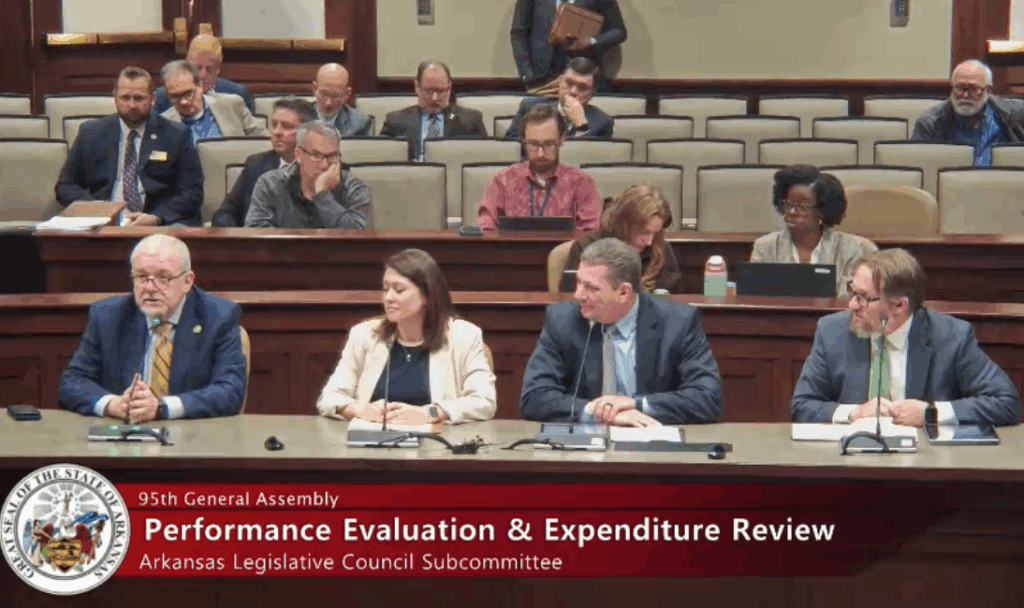
At today’s Legislative Council PEER Review meeting lawmakers approved another $32 million for the state’s Education Freedom Account (EFA) program, also known as school vouchers. Both lawmakers and education department personnel acknowledged that meaningful accountability for EFAs is limited and largely based on the honor system.
When EFAs were passed in 2023, legislators were told the program would serve about 28,000 students, according to Rep. Fran Cavenaugh. Today the Arkansas Department of Education (ADE) confirmed the program is already funding more than 44,000 students; the program is expected to continue to grow.
To cover the additional $32 million, ADE requested a transfer from the state’s Restricted Reserve Fund. This tranche of funding is typically used for one-time legislative initiatives, funding emergencies, or budget deficits. But ADE asked lawmakers to use the one-time monies to prop up vouchers – an expenditure that’s actually a permanent budget expense. As Rep. Cavenaugh pointed out, EFAs should be funded through the state’s Revenue Stabilization Act, or RSA.
Several lawmakers warned ADE that the request creates a problem the state can’t avoid forever. That is, funding universal EFAs will eventually force the state to make tough choices about what doesn’t get funded.
Honor system oversight 🤔
Lawmakers spent time pressing ADE on reports of questionable EFA purchases (like paintball, gaming chairs, family vacations, and more). They asked ADE staff whether or not safeguards exist to prevent fraud or misuse of funds. ADE’s answers were pretty blunt. Tl;dr? No safeguards.
- Once EFA money reaches a family, it is no longer state property
- Homeschooling parents are not required to purchase a curriculum in order to receive funds
- The state does not track items, serial numbers, or verify continued use of purchased items
- The state may never be able to detect if items were returned for cash
- ADE cannot identify EFA fraud in real time
When asked if the state checks that purchased items are actually kept and used, ADE said no. The program, officials explained, is built on parental trust for the sake of “parental empowerment.”
Double standard
ADE’s framing is striking when compared to how Arkansas’s supermajority typically talks about other public programs. Medicaid recipients, for example, face intense scrutiny. Newer laws like work requirements and rapid disenrollment procedures were enacted over concerns about fraud. This is despite the fact that Medicaid and work support fraud is rare and, as ADE admitted today, unavoidable in any government program.
But when tens of millions in EFA dollars flow with such little oversight, taxpayers are told to trust the system.
Even supporters of EFAs acknowledged what we critics have warned from the beginning: accountability is much harder to enforce after the money is already out the door.